

Phytochemical and pharmacological properties of acetone extract fromCurcuma vitellina
Aннотация
Background:Curcuma vitellina has been recently described as a new species in the flora of Vietnam. To date, it is a rare species and its phytochemical and biological properties are limited. The aim of the study:The present study reports for the first time the chemical components and pharmacological properties of acetone extract of Curcuma vitellina, a native species from Vietnam. Materials and methods: The chemical components, antibacterial and antioxidant activitiesof the studied extract were identified using gas chromatography/mass spectrometry (GC/MS), agar disk-diffusion, and DPPH radical scavenging assays, respectively. Results: Forty-eight compounds were identified in the studied extract of which the major compounds were caryophyllene oxide (14.08%), (E)-labda-8(17),12-dien-15,16-dial (11.30%), longiverbenone (10.53%), 2-pentanone, 4-hydroxy-4-methyl- (9.98%), n-hexadecanoic acid (5.57%), and γ-bicyclohomofarnesal (5.13%). In addition, the studied extract was found to be effective against Gram-positive strains, including S. aureus ATCC 29213, S. aureus ATCC 25923, B. cereus and S. saprophyticus whereas while four Gram-negative strains were not sensitive to this extract. The C. vitellina extract also presented the DPPH scavenging capacity with IC50 value of 614.55 µg/mL. Conclusion: The results from this report are to provide the potential application of the Curcuma vitellina extract in biomedicine and other related fields
К сожалению, текст статьи доступен только на Английском
Introduction. Curcuma L., one of the large genera belonging to the family Zingiberaceae, has about 120 species distributed in subtropical and tropical areas, but widely found in Malaysia, Indochina, northern Australia, Thailand, Vietnam, etc. [1, 2]. About twenty-nine species of the genus Curcuma have been recorded in the flora of Vietnam, of which many species are native [1, 3, 4]. Quite a lot of Curcuma species have been utilized for many purposes like flavoring, medicinal, and preservative effects properties [2]. In addition, a large number of Curcuma species have also been known as the ethnomedicinal plants to cure many diseases such as infectious wounds, abscesses, bronchial complaints, insect bites, leucorrhea, diarrhea, and pneumonia [5]. The chemical composition and biological properties of essential oils and other extracts obtained from Curcuma plants have been described in previous studies [6-9].
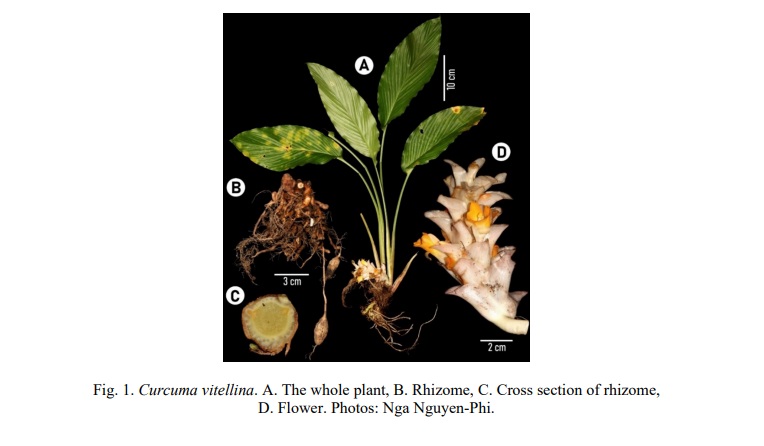
Curcuma vitellina Skornick. & H. Đ. Tran, a native species from Vietnam, was first discovered by Leong-Škorničková et al. in 2010. The type specimens were collected in Lam Dong province [10]. This species is characterised by the following morphological features: the plant is about 70 cm high; the inflorescence consists of the greenish or cream flower bracts on the tips and missing a distinct coma, a highly developed crest and two filamentous spurs at the base; the leaf blade possesses a rounded base, thin and glabrous on both sides. The flowering time of this plant occurs from June to August. To date, C. vitellina is a rare species, and our prior work is the only study to have investigated the chemical components and antibacterial profiles of the essential oils isolated from C. vitellina [11]. Thus, this study was the first to investigate the chemical composition, antibacterial and antioxidant properties of acetone extracts obtained from C. vitellina.
Material and methods
Plants
The whole plants of C. vitellina were collected from the coordinates GPS: 12.459427; 108.463261, Chu Yang Sin National Park, Daklak province, Vietnam (Fig. 1). The voucher specimen (NPN-1078) was deposited at the Herbarium of the University of Science, Vietnam National University HCMC (PHH).
Four Gram-positive strains (Staphylococcus aureus ATCC 25923, Staphylococcus aureus ATCC 29213, Staphylococcus saprophyticus BAA750, Bacillus cereus ATCC 13883) and four Gram-negative strains (Enterobacter hormaechei ATCC 700323, Salmonella typhimurium ATCC 13311, Escherichia coli ATCC 25922, Shigella flexneri ATCC 9199) were used to determine the antibacterial activities of the C. vitellina extract.
Extraction procedures
The whole plant of C. vitellina was dried at 50oC, then ground into powder. Five hundred milliliters of acetone solution (Thermo Fisher Scientific, USA) were used to soak one hundred grams of the powder within 72 hours at room temperature. The Whatman filter paper was used to filter the mixture solution. Three hundred milliliters of acetone solution were used to soak the filter residue two more times to collect the final filtrate. The filtrate was evaporated at 45℃ using a vacuum evaporator to obtain the brown extract [12].
Gas chromatography/mass spectrometry (GC/MS)
The chemical composition of C. vitellina was identified using the TRACE 1310 Gas Chromatograph (Thermo Fisher Scientific Inc., Waltham, MA, USA) coupled with ISQ 7000 single quadrupole mass spectrometer. The injector temperature was held at 250℃ in the flow rate 36 mL/min, split ratio of 30:1. The DB-5MS column (30 m x 0.25 mm x 0.25 µm) was used as the stationary phase with the helium carrier gas flow rate at 1.2 mL/min. The mass spectrometer was set at an ion source temperature at 250℃ and ionization voltage 70 eV. The oven temperature was set at 80℃ for 5 min, then increased by 20℃ per minute until it reached 280℃. The oven was then held at 280℃ for 10 min. The acquisitions scan mass range of MS was 29-650 m/z with the scanning frequency of 2 scans/sec. The NIST 2017 library was used to identify the chemical compounds of the studied extract based on their mass spectral comparison.
Antibacterial activity
The agar disk-diffusion method was used to identify the antibacterial properties of C. vitellina [13]. The LB broth was used to grow eight oral bacteria until they reached a turbidity of 0.5 McFarland standards. Then, 100 µL of the bacterial solution was spread onto a Mueller Hinton plate. The extract was diluted with 15% DMSO solution at the concentration of 100, 150 and 200 mg/mL. Ten microliters of sample solution were injected into a paper disc (6 mm diameter). The petri dishes were then incubated at 37℃ within 24 hours. The zone of inhibition was measured using the formula A = D – d, where D is the zone of inhibition and d is the diameter of disc (6 mm). The positive control in this study was Gentamicin (Nam Khoa BioTek, Vietnam) while the negative control was 15% DMSO solution.
Antioxidant activity
The antioxidant effect of the studied sample was identified using the DPPH radical scavenging method [12]. The different concentrations of the studied extract were obtained by diluting with 99.8% methanol (Thermo Fisher Scientific, USA). 3.7 ml of a 0.1 mM DPPH solution was mixed with 0.3 ml of the studied solution. The mixture was then incubated for 30 minutes at room temperature in the dark. Absorbance was measured at a wavelength of 517 nm using a UV-Vis spectrophotometer (Genesys 20, USA). Ascorbic acid was used as a control agent and the antioxidant effect of the studied extract was determined by the equation:

where Ao: the absorbance of the blank solution (DPPH solution) and Ai: the sample (DPPH solution and extract).
Data analysis
The experiments were conducted in three replicates. The Excel software was used to identify the average values and standard deviation. The statistical methods of one-way analysis of variance (ANOVA) and Fisher's least significant difference (LSD) were employed (Statgraphics Centurion XV program).
Results
Chemical composition of acetone extract from Curcuma vitellina
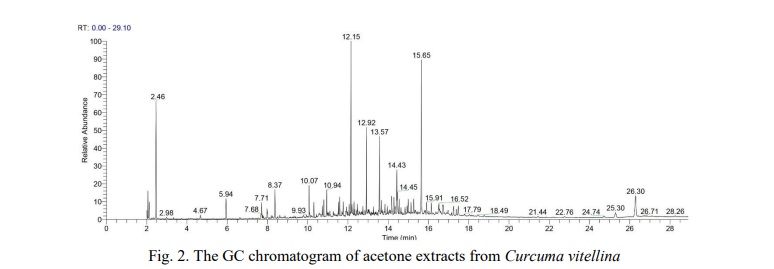
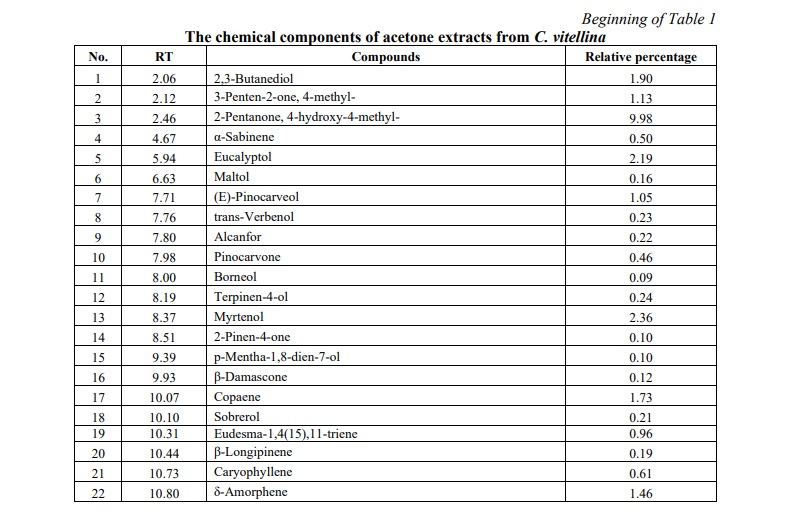
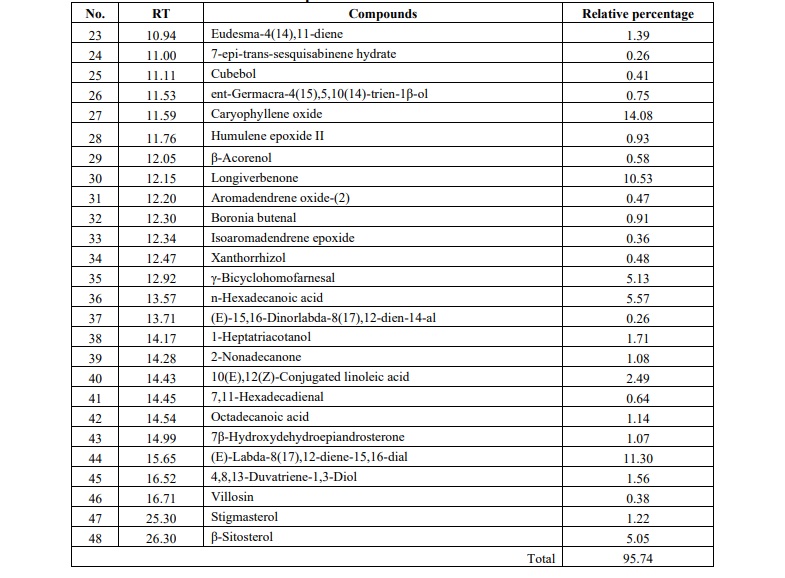
The chemical composition of the acetone extract of C. vitellina was presented in Figure 2 and Table 1. Overall, forty-eight compounds were identified in the studied extract of which caryophyllene oxide (14.08%), (E)-labda-8(17),12-diene-15,16-dial (11.30%), longiverbenone (10.53%), 2-pentanone, 4-hydroxy-4-methyl- (9.98%), n-hexadecanoic acid (5.57%), ambrial (5.13%), β-sitosterol (5.05%) were the major components.
The chemical components of the essential oils and the acetone extracts isolated from the various Curcuma species collected in Vietnam using gas chromatography/mass spectrometry have been recently investigated. For instance, our report recently demonstrated that the essential oil from C. vitellina was found to be rich in 1,8-cineole, β-pinene, longiverbenone, and α-pinene [11]. The acetone extract of C. thorelii was found to contain (E)-labda-8(17),12-diene-15,16-dial, vitamin E and phytol, while the essential oil isolated from this species was found to contain xanthorrhizol, β-curcumene and ar-curcumene as its main constituents [15]. Similarly, the acetone extract of C. xanthella was characterized by the predominance of 1,8-cineole, n-hexadecanoic acid, and stigmasterol [16] while velleral and 1.8-cineol were the main components in the essential oils of two aerial part samples of this species collected in two different habitats in Binh Chau-Phuoc Buu Nature Reserve [17]. The main components of the essential oil isolated from the rhizome of C. gracillima were α-curcumene, 3,4-dimethylanisole and 2-bornanone, whereas the major compounds in the acetone extract of C. gracillima were n-hexadecanoic acid, β-caryophyllene and (E)-labda-8(17),12-diene-15,16-dial [9, 12]. In addition, the acetone extract of C. cotuana was found to be primarily composed of (E)-labda-8(17),12-diene-15,16-dial, n-hexadecanoic acid, and 3,7,11,15-tetramethylhexadec-2-en-1-yl acetate [14]. The acetone extract of C. pierreana was characterised by the presence of large quantities of n-hexadecanoic acid, (E)-labda-8(17),12-diene-15,16-dial and cis-13-octadecenoic acid [12]. The essential oil of the C. pygmaea aerial part contained β-pinene, caryophyllene, and caryophyllene oxide as the major constituents [18].
The chemical composition of the C. vitellina extract in this study was also reported to possess biological properties. For example, (E)-Labda-8(17),12-diene-15,16-dial, a specific compound found in various Curcuma species and other Zingiberaceae species [19, 20, 21], showed cytotoxic activities against Ca Ski, MCF-7, HT-29, and PC-3 [22]. Caryophyllene oxide and caryophyllene, two natural sesquiterpenoids, have also been reported to have anti-cancer effects due to their impact on the proliferation of various cancer cell lines [23, 24]. γ-Sitosterol has also been reported to have an antidiabetic effect and to inhibit the proliferation of several cell lines, including rA549 and MCF-7 [25, 26]. Studies have demonstrated that β-sitosterol and stigmasterol have antioxidant [27], antidiabetic [28], anti-inflammatory [29], immunomodulatory [30], sedative and anxiolytic [31], hepatoprotective [32], and protective effect against pulmonary fibrosis [33] properties. Another study postulated that longiverbenone possessed the cytotoxic activity on brine shrimp (Artemia salina) with LC50 value of 14.38 µg/mL [34]. In addition, the cytotoxic effects against human cancer cells of longiverbenone were also provided by prior studies [35].
Antibacterial property of acetone extract from Curcuma vitellina
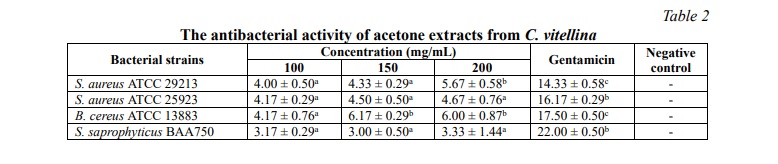
The antibacterial effects of the acetone extract isolated from C. vitellina were shown in Table 2. The results demonstrated that the studied extract displayed activity against four Gram-positive strains while four Gram-negative strains were not sensitive to this extract. Overall, the antibacterial effects of the extract against S. aureus ATCC 29213 and B. cereus ATCC 13883 at a concentration of 200 mg/mL were better than those of the lower concentrations, whereas no significant difference in zone of inhibition was observed among the three dilutions for S. aureus ATCC 25923 and S. saprophyticus BAA750. Our recent work showed that the essential oil isolated from C. vitellina rhizome displayed activity against three fungal strains and eleven oral bacterial, including S. saprophyticus, S. aureus, B. cereus, V. parahaemolyticus, P. aeruginosa, E. coli, S. typhimurium, S. flexneri, S. enteritidis, K. pneumoniae, L. monocytogenes, C. krusei, C. albicans, and C. tropicalis [11].
Studies have recently demonstrated the antibacterial activities of the essential oils and other acetone extracts obtained from the various Curcuma species collected in Vietnam. For instance, the acetone extract from the whole plant of C. thorelii had an inhibitory effect on L. monocytogenes, B. cereus,S. aureus ATTC 29213, S. aureus ATTC 25923, and S. saprophyticus [14] while the rhizome essential oil from this species displayed activity against B. cereus, S. typhimurium, S. enteritidis, P. aeruginosa, and E. coli [15]. Similarly, the acetone extract of C. xanthella was found to be effective against B. cereus, Staphylococcus, Escherichia coli, K. pneumoniae, S. flexneri, S. enteritidis, S. typhimurium, and P. aeruginosa [16], while the essential oil of this plant was found to be effective against V. parahaemolyticus, L. monocytogenes, S. saprophyticus, S. aureus, and S. enteritidis [17]. In addition, essential oil derived from the aerial parts of C. pygmaea has been shown to have inhibitory effects against S. flexneri, B. cereus, E. faecalis and L. monocytogenes [18]. Moreover, B. cereus was sensitive to the acetone extract obtained from C. cotuana [14].
The antibacterial properties of the acetone extract of C. vitellina may be attributed to the presence of certain chemical compounds in the extract. For example, it was believed that longiverbenone had antibacterial effects against many bacterial strains, including Bacillus subtilis, Bacillus cereus, Bacillus megaterium, Escherichia coli, Vibrio cholerae, Shigella dysenteriae, Shigella sonnei, Salmonella typhimurium and Salmonella paratyphi [34]. According to Anwar et al., β-sitosterol was potently active against K. pneumonia and S. aureus [36]. β-Caryophyllene displayed activity against many microorganisms, including B. subtilis, B. cereus, P. aeruginosa, K. pneumonia, S. aureus, E. coli, P. citrinum, A. niger, T. reesei, and R.oryzae [37]. Recently, n-hexadecanoic acid has been reported to have antibacterial effects against E. coli, B. subtilis, K. pneumoniae, and S. aureus [38].
Antioxidant activity of acetone extracts from Curcuma vitellina
The antioxidant activity of the acetone extract from C. vitellina was presented in Table 3. Accordingly, the DPPH scavenging capacity of the studied extract was found to have an IC50 value of 614.55 µg/mL, whereas the control agent ascorbic acid had an IC50 value of 2.24 µg/mL.

The antioxidant properties of the different solvent extracts obtained from Curcuma species have been reported by previous studies. For instance, the acetone extracts of C. gracillima and C. pierreana showed DPPH radical scavenging activity with an IC50 value of 1.76 and 2.97 mg/mL, respectively [12]. The acetone extract obtained from C. xanthella possessed DPPH radical scavenging effect with IC50 value of 6.60 mg/mL while three fractions from the acetone extract from this plant such as chloroform n-hexane, and ethyl acetate were active against this radical scavenger with IC50 value of 8.45, 2.38, and 3.42 mg/mL, respectively [16]. The methanol extract of C. aromatica was reported to possess DPPH and ABTS radical scavenging properties with IC50 values of 129.00 and 25.29 µg/mL, respectively [39].
In addition, the chemical constituents of the acetone extract from C. vitellina in this report could be the main factor contributing to its antioxidant activity. For example, Ganesan et al. (2022) found that an n-hexadecanoic acid concentration of 100–500 µg/mL scavenged ABTS, DPPH, superoxide, nitric oxide and reducing power by 42.18–83.86%, 30.19–89.13%, 17.18–81.21%, 18.65–73.17% and 0.02–0.16%, respectively [38]. The antioxidant activity of β-sitosterol has also been reported. Accordingly, at a dose of 25–150 µg/mL, this compound exhibited DPPH and H₂O₂ radical scavenging properties, with percent inhibition ranging from 10.84% to 84.29% and from 10.38% to 62.49%, respectively [40].
Conclusion. This study is the first to investigate the chemical composition and pharmacological properties of the acetone extract from Curcuma vitellina. Along with other valuable species belonging to the Curcuma genus, the results of this report will hopefully provide a basis for further applications of this species in biomedicine and the pharmaceutical industry.
Financial support
No financial support has been provided for this work.



















Список литературы