

JAK2 intragenic deletion associated with chromosome instability and neurodevelopmental disease
Abstract
Background: Copy number variations and chromosome instability are common causes of neurodevelopmental diseases. However, associations between copy number genomic changes, chromosome instability and brain dysfunctions are rarely described due to the lack of focus on the interplay between these phenomena. The aim of the study:To describe two cases of an association between an intragenic deletion within exon 5 of the JAK2 gene, chromosome instability and neurodevelopmental disease. Materials and methods: Two girls presenting with intellectual disability, epilepsy, autistic traits and congenital anomalies were studied using cytogenetic and molecular cytogenetic approaches, including SNP-array analysis and original bioinformatic methods. Results: Two unrelated girls with neurodevelopmental disorders and chromosome instability were found to carry an identical intragenic deletion affecting exon 5 of the JAK2 gene. No additional pathogenic copy number variants associated with neurodevelopmental disease or chromosome instability were detected. Interactome analysis revealed enrichment of the JAK-STAT, PI3K-Akt, and cytokine signaling pathways, highlighting the involvement of JAK2 in genome maintenance and cellular homeostasis. Conclusion: The findings suggest that intragenic deletions of JAK2 may represent a rare molecular genetic mechanism linking chromosome instability and neurodevelopmental disease. These observations support the role of copy number variations affecting key signaling pathways in the pathogenesis of brain disorders associated with genomic/chromosomal instability
Keywords: intragenic copy number variant, deletion, epilepsy, intellectual disability, neurodevelopmental disorder, JAK2, JAK-STAT signaling
Introduction. Copy number variations (CNVs) are recognized as an important contributor to brain dysfunction and neurodevelopmental disorders. Moreover, CNVs commonly alter genes involved in critical intracellular pathways shaping the genetic landscape of brain (neurodevelopmental) disorders [1, 2]. A wide spectrum of molecular pathways (i.e., from neuronal signaling/axon guidance to programmed cell death) is changed either by single or by a combination of CNVs in brain diseases [2, 3]. It is noteworthy that these molecular pathways are not necessarily related to brain functioning per se. In other words, brain diseases may result from alterations to universal pathways critical for cellular and tissue homeostasis [3, 4]. One of these pathways is genome stability maintenance, alterations to which produce genomic or chromosomal instability. Genome instability represents a common mechanism for brain diseases. Intercellular instability at chromosomal and molecular levels may affect specifically brain tissue (tissue-specific instability/mosaicism) to initiate a pathogenic cascade leading to neurodevelopmental, neurobehavioral, neurodegenerative or psychiatric disease [5-9]. Analyses of cancer cells/tissues, which systematically demonstrate genome/chromosome instability, demonstrate that mutational changes within the genes involved in genome-safeguarding pathways are the most recognized molecular genetic cause of genomic instability [10]. More importantly, similar mechanisms are observed in other types of diseases associated with genome instability (e.g., immunological diseases, neurodegenerative disorders). Genome and chromosome instability is an important part of pathogenetic cascades leading to disease and aging [7, 11].
According to an accepted model of genome instability involvement in brain dysfunction, a mutation (gene mutations, CNVs or chromosomal abnormalities) initiates instability, which provokes intracellular pathologic changes [12, 13]. There is a growing number of cases demonstrating CNVs/gene mutations associated with chromosome/genome instability in brain diseases [7, 9, 12]. Here, we report two individuals with neurodevelopmental diseases, chromosome instability and identical deletions in exon 5 of the JAK2 gene, a component of JAK-STAT signaling pathway implicated in vital cellular processes generally related to cancer and inflammation [14].
The aim of the study. To describe two cases of an association between an intragenic deletion within exon 5 of JAK2, chromosome instability and neurodevelopmental disease (intellectual disability, epilepsy with autistic traits).
Materials and methods. Two individuals with JAK2 deletions were retrieved from a neurodevelopmental cohort of 802 children with intellectual disability, autism spectrum disorders, epilepsy and/or congenital malformations analyzed using molecular karyotyping by SNP array (platform: CytoScan HD Arrays by Affymetrix (Santa Clara, CA); ~2.7 billion markers/~750,000 SNPs), as described earlier [12, 15]. Original bioinformatic methods for prioritization of CNVs using system biology analyses for in silico modulating functional consequences of genomic copy number changes [3, 12, 16]. These approaches to CNVs prioritization are based on in silico analysis of transcriptome, interactome (proteome) and metabolome [3, 16]. Interactome analysis of the gene deleted in affected individuals was made by STRING DB, https://string-db.org/ [17]. Cytogenetic analysis was performed using classical karyotyping by G- and C-banding [12]. Metaphase chromosomes were analyzed and karyotypes were interpreted according to the recommendations of the International System for Human Cytogenomic Nomenclature (ISCN 2024) [18].
Results and discussion. We report the results of an analysis of two girls with neurodevelopmental disorders examined using chromosomal microarray analysis (SNP-array) and cytogenetic methods. The first patient (6 years old) presented with temporal lobe focal epilepsy, mild intellectual disability, a speech delay and autistic traits. The second patient (2 years old) exhibited moderate intellectual disability accompanied by hyperactivity, abnormal fear responses, ataxia, facial dysmorphisms, and epileptiform activity on EEG. Genome-wide SNP-array analysis identified identical deletions (size: 6,862 bp; 9p24.1; chr9:5,040,373–5,047,234; hg38) in both individuals. This deletion affected exon 5 of JAK2 (Fig. 1).
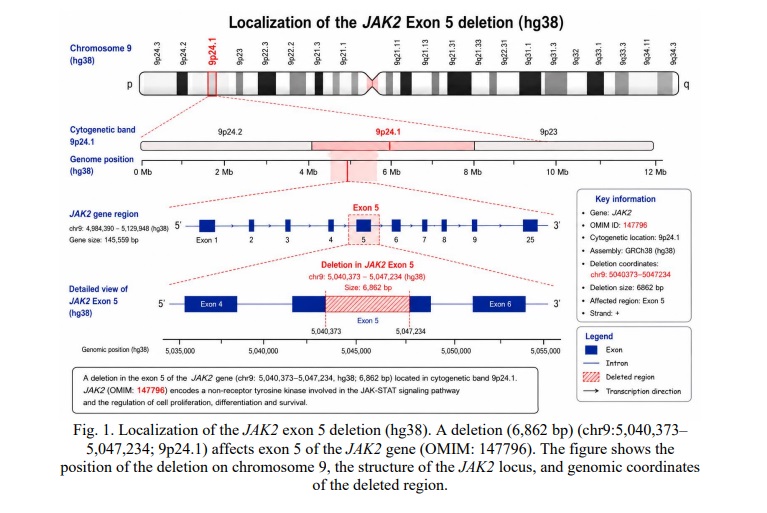
Since CNVs constitute a substantial component of genomic variability influencing diverse biological processes and disease phenotypes according to the variome concept, [3] other detectable CNVs were addressed in the pathogenic context. Consequently, no additional pathogenic or likely pathogenic copy number variants associated with neurodevelopmental disorders, epilepsy, intellectual disability, autism spectrum disorders, or chromosome instability were found. JAK2 deletion was concluded to represent the unique, albeit recurrent genomic change, which is associated with shared clinical and cytogenetic findings in both patients. Thus, the application of high-resolution genome-wide SNP-array has enabled precise detection of an intragenic deletion affecting the JAK2 gene and exclusion of additional clinically irrelevant genomic imbalances. Such approaches have proven valuable for detecting disease-associated genomic alterations and characterizing complex genomic landscapes in both constitutional and acquired disorders [12, 15].
G-banding analyses of girls’ karyotypes demonstrated multiple structural and morphological abnormalities (non-specific translocations, chromosome loss and fragility) resulted in chromosome instability in both patients (Fig. 2). Chromosome instability and somatic chromosomal mosaicism are common mechanisms underlying neurodevelopmental, psychiatric, and neurodegenerative disorders [5-9, 16]. Genome instability may arise through DNA repair defects, chromosome segregation errors, or other alterations to genome maintenance pathways and can contribute to disease pathogenesis by generating cellular heterogeneity and genomic imbalance [11, 12, 13]. The karyotypic alterations involved several non-homologous chromosomes and were not restricted to a single chromosomal region, suggesting a generalized defect in genome maintenance rather than local alterations to chromosomal structures. The coexistence of chromosome instability and identical intragenic JAK2 deletions in two unrelated patients supports the possibility that abnormal JAK2 functioning contributes to genome instability.
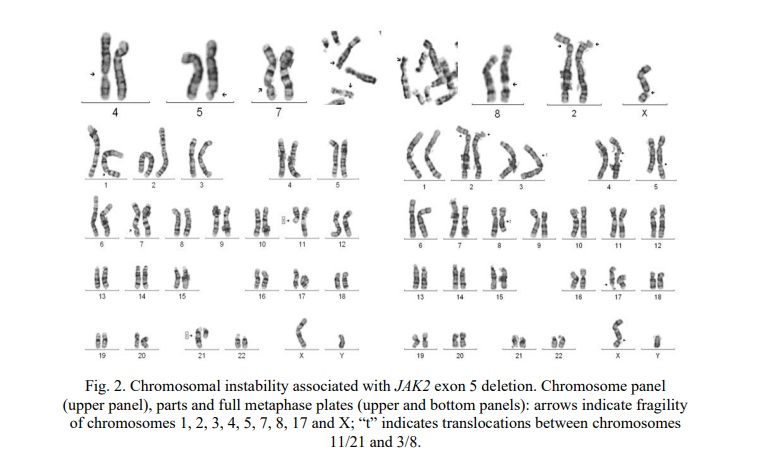
Although JAK2 is primarily known as a central component of the JAK-STAT signaling pathway, recent studies indicate a broader role in cellular homeostasis, signal transduction, and maintenance of genomic integrity [14, 19, 20]. JAK2-dependent signaling has been implicated in regulation of cell-cycle progression, DNA damage response, mitotic spindle checkpoint control, cellular survival, and inflammatory signaling [19, 20]. Empirical data suggest that JAK2 participates in safeguarding chromosome segregation and genome stability, whereas JAK2 dysfunction may result in chromosome missegregation and accumulation of genomic unrepaired damage. Chowdhury et al. have shown that JAK2-CHK2 signaling is required for the correct functioning of the mitotic spindle assembly checkpoint and the preservation of genome stability. This provides a plausible mechanistic link between JAK2 deficiency and chromosome (genome) instability [21].
Interactome analysis has revealed significant enrichment of proteins participating in the JAK-STAT signaling pathway, cytokine-cytokine receptor interaction, and PI3K-Akt signaling pathway (Fig. 3). These pathways are involved in regulation of cell proliferation, apoptosis, immune responses, neuronal development, and maintenance of cellular homeostasis [19, 20]. In addition, several interaction partners of JAK2 were linked to mechanisms associated with DNA damage response, cell-cycle regulation, and genome surveillance, providing further support for a potential connection between JAK2 haploinsufficiency and chromosome instability.
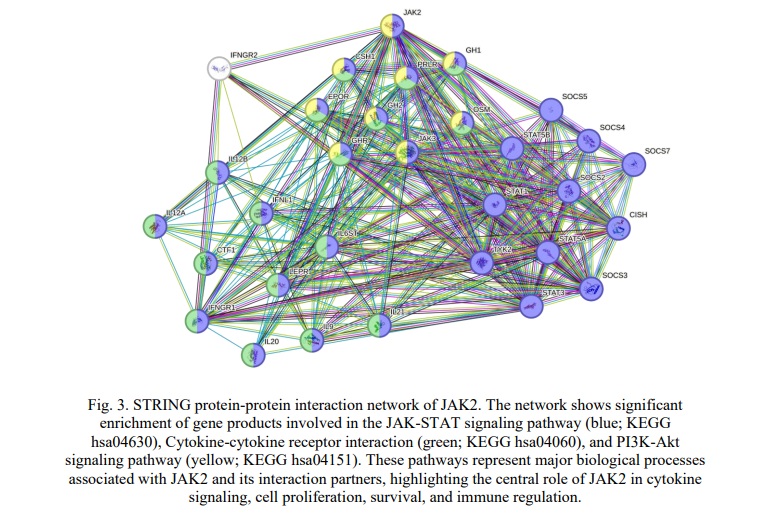
The JAK-STAT pathway has also been implicated in neurodevelopment and neuronal maintenance [19]. Dysregulation of this signaling cascade has been associated with intellectual disability, autism spectrum disorders, epilepsy, and neurodegenerative diseases. Recent studies have evidenced that JAK2/STAT3 signaling may represent an important molecular target in neurodegenerative disorders through an effect on neuroinflammation, neuronal survival, and neural network homeostasis [22]. Therefore, deletion of exon 5 of JAK2 may contribute to disease pathogenesis through a dual mechanism involving both altered neuronal signaling and increased chromosomal instability. The convergence of these processes may represent a pathogenic cascade linking a single-gene copy number variant to genome instability and neurodevelopmental abnormalities.
Conclusion. We describe two unrelated individuals with neurodevelopmental disorders and chromosome instability carrying an identical intragenic deletion affecting the JAK2 gene. Interactome analysis highlighted the involvement of JAK2 in signaling networks related not only to cytokine signaling and neuronal function, but also to genome maintenance and cellular homeostasis. These observations support the hypothesis that copy number variations affecting genes involved in fundamental cellular pathways may contribute simultaneously to chromosome instability and brain dysfunction. Accordingly, JAK2 intragenic deletions may represent a rare molecular genetic mechanism linking genomic instability to neurodevelopmental disease. Given the limited number of reported cases involving disruption of JAK-STAT signaling components in the context of chromosome instability and neurodevelopmental or neurodegenerative disorders, further studies are needed to clarify the pathogenic role of JAK2 alterations and to better understand the molecular mechanisms linking signaling pathway dysfunction, genome instability, and neurological disease. However, it appears that the uncovered mechanism for brain dysfunction mediated by genome instability might be relevant for additional neurodevelopmental and neurobehavioral diseases [7, 23]. Moreover, genome instability and somatic chromosomal mosaicism confined to brain areas are important parts of pathogenetic cascades producing devastative neurodegenerative and psychiatric diseases [24]. In the light of the present finding, it seems important to mention that there is as potential to design successful therapies for diseases resulted from JAK-STAT pathway defects [25]. Accordingly, it can be suggested that such therapeutic interventions are effective in treating neurodevelopmental diseases associated with JAK-STAT alterations. In total, one may conclude that studies highlighting interplay between intragenic CNVs, genome/chromosome instability and neurodevelopmental disorders possess not only basic value for understating fundamental biomedical principals, but also diagnostic and practical meaning providing new opportunities for successful treatment of childhood brain diseases.
Financial support
This work was supported by the Ministry of Science and Higher Education of the Russian Federation (Federal Scientific and Technical Programme for Genetic Technologies Development for 2019-2030, Agreement № 075-15-2025-474.
Thanks
We would like to express our gratitude to Dr. Irina A. Demidova and Dr. Alexey D. Kolotii



















Reference lists